Drum Pedals are 100 years behind the times when it comes to driveshafts!
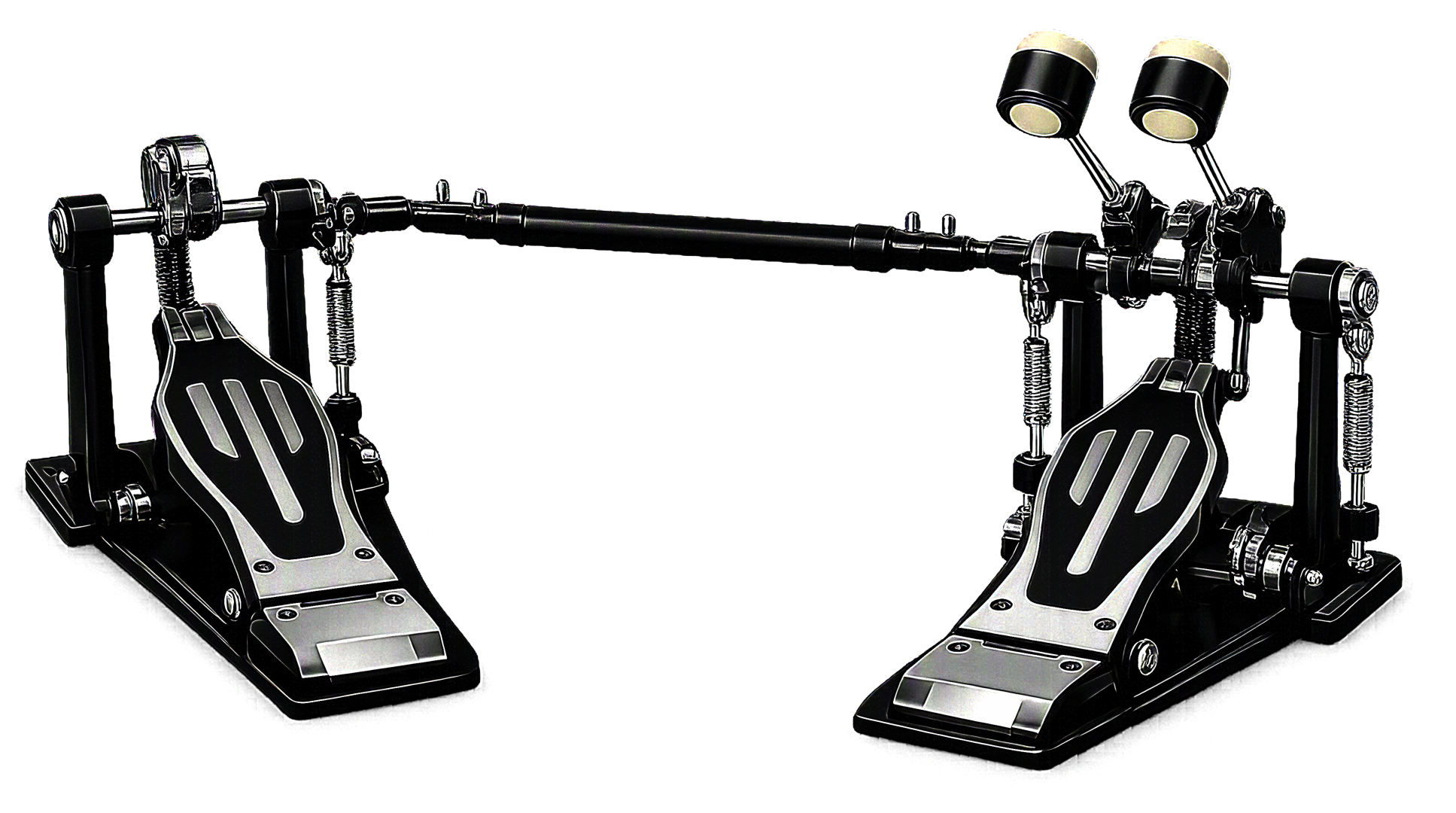
Modern pedals rely on joints which originated from gimbles for ancient oil lamps and ship compasses from the 16th century!
The scarcity of constant velocity (CV) joints on double bass drum pedal driveshafts stems from a fundamental gap in geometric understanding: most drummers attribute slave-pedal lag to spring tension or footboard mass rather than rotational kinematics, leaving drum hardware manufacturers with little market incentive to justify higher homokinetic engineering costs.
But what are CV Joints and What are those ‘non CV’ Joints.
Cardan vs. CV Joint Kinematics
A Constant Velocity (CV) joint is a mechanical coupling that transmits rotational torque through an adjustable angle at a constant velocity ratio
Eliminating the speed fluctuations, vibration, and mechanical stress inherent in standard universal (Cardan) joints.
Key Historical Milestones
Early 1900s Motivation:
Standard universal joints worked well for rigid rear-axle drives, but caused severe vibration, binding, and power surges when applied to steerable front wheels on front-wheel-drive prototypes.
Drum pedals today are at this 1900s stage. Pedals today…even the most sophisticated… are therefore 100 years behind the times when it comes to driveshafts!
Weiss Joint (1925):
Carl W. Weiss patented one of the first ball-type CV joints, using grooved tracks with steel balls to split the operating angle evenly between input and output shafts.
Tracta Joint (1926):
Invented by French engineer Jean-Albert Grégoire, this design used interlocking sliding joints instead of balls.
It was widely adopted in early front-wheel-drive race cars and military vehicles like WWII amphibious crafts and Jeeps.
Rzeppa Joint (1927–1936):
Ford engineer Alfred H. Rzeppa perfected the outer ball-and-cage joint. By keeping six rolling balls centered precisely on the homokinetic plane,
Rzeppa created a smooth, durable joint capable of high articulation angles.
Mass Adoption (1959):
Alec Issigonis incorporated Rzeppa-style CV joints into the iconic original Morris Mini.
The Mini's commercial success established CV driveshafts as the worldwide standard for front-wheel-drive passenger vehicles and modern independent suspension systems.
Standard double pedals rely on Cardan (universal) joints, which exhibit non-linear output velocity when operating at an the slightest angle
Cardan Joints
A Cardan universal joint (also known as a U-joint or Hooke's joint) is a mechanical coupling that uses a cross-shaped pivot (spider) to connect two rigid shafts inclined at an angle, allowing torque transmission across a flexible joint.
Unlike a constant velocity joint, a single Cardan joint operating at an angle does not maintain a steady 1 to 1 output ratio;
it causes continuous velocity fluctuations—accelerating and decelerating—which creates vibration and mechanical stress.
Key Historical Milestones
Gimbal Roots (Antiquity):
The underlying cross-pivot principle grew out of ancient Greek and Chinese gimbal mechanisms used to keep oil lamps, incense burners, and navigational tools level.
Girolamo Cardano (1545):
Italian mathematician Girolamo Cardano proposed using multi-axis gimbal suspensions to keep marine compasses steady at sea.
His work popularized the mechanism in Europe, giving the joint its continental name.
Robert Hooke (1676):
English scientist Robert Hooke invented the first torque-transmitting universal joint to control clockwork devices.
Hooke analyzed its non-linear kinematics, discovered its output speed fluctuations, and demonstrated that combining two joints out-of-phase could cancel out the speed ripple.
Clarence Spicer (1903):
American engineer Clarence W. Spicer patented an enclosed, lubricated universal joint driveshaft for automobiles.
Spicer's design eliminated noisy, high-maintenance drive chains and established the Cardan joint as the standard for rear-wheel-drive motor vehicles throughout the 20th century.
Advantages of CV Joints over U-Joints
Elimination of Rotational Speed Ripple: Guarantees zero velocity fluctuation, ensuring the slave beater mirrors the master pedal's exact stroke acceleration throughout the entire arc.
Angle Independence: Permits asymmetric slave pedal positioning without introducing non-linear pedal drag or footboard binding.
Zero Backlash & Instantaneous Impulse: Eliminates phase lag and micro-slop during high-speed double strokes, heel-toe patterns, and blast beats.
Reduced Peak Bearing Load: Removes periodic torsional shock loads from bearing journals, extending shaft component lifespan.
Landmark Driveshafts in Drum Hardware
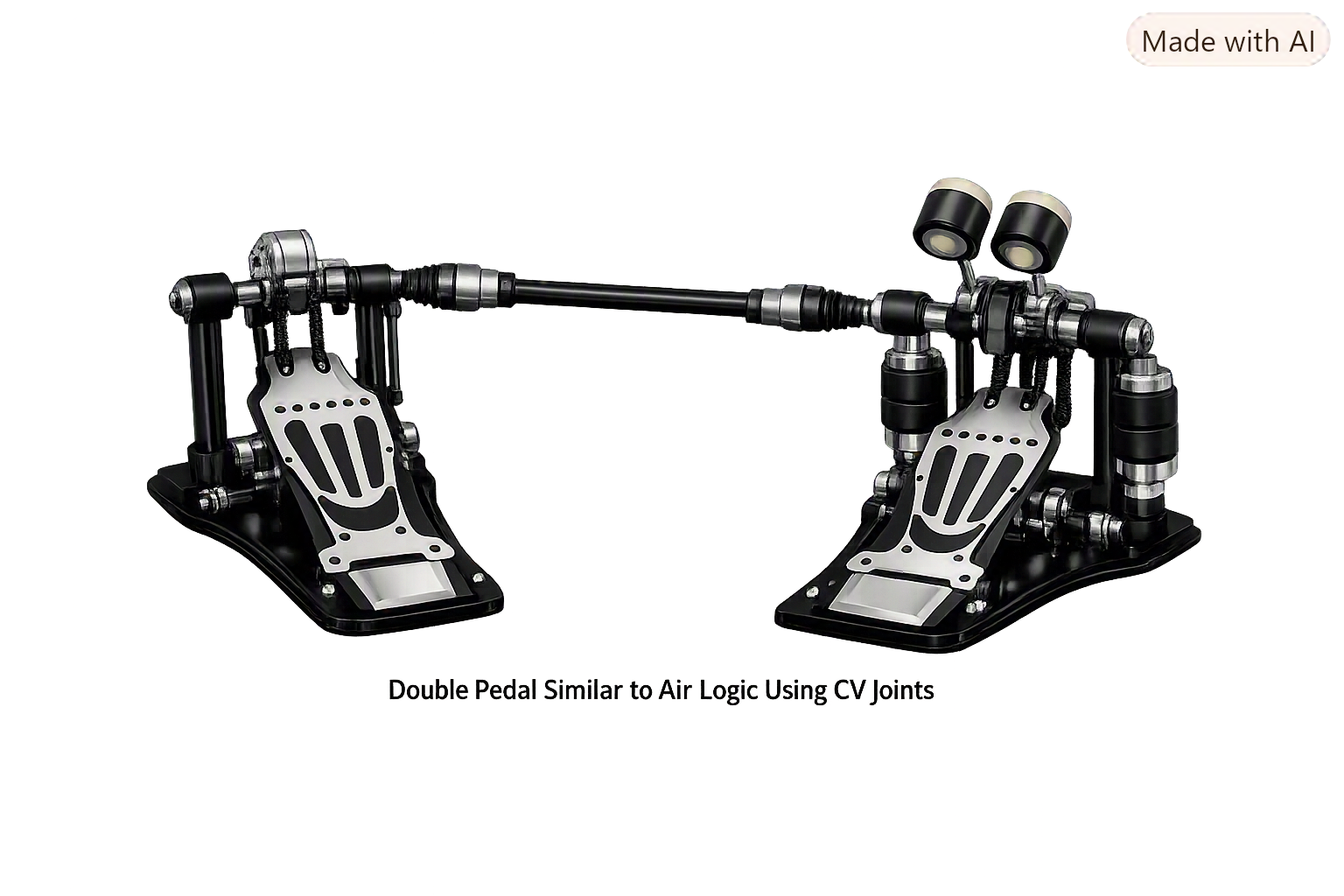
Air Logic Pedals:
A rare commercial pioneer featuring stainless steel constant velocity, zero-backlash joints. Combined with pneumatic return cylinders, it eliminates both spring non-linearity and joint speed ripple.
AXiS Driveshaft
Built with aircraft-grade aluminum rods and four stainless steel micro-bearings per joint. While offering minimal rotational inertia, its cardan architecture requires precise phasing to minimize speed variations.
Tama Mirror Rod TMR1000:
Features 8 precision ball bearings located close to the central axis to minimize latency. Despite virtually eliminating bearing play, its U-joint geometry remains sensitive to asymmetric operating angles.
Comparison to Symmetrical Drumming Australia V Series
While the Tama Mirror Rod focuses on minimizing bearing clearance and the AXiS Driveshaft reduces rotational mass, both remain susceptible to Cardan velocity fluctuation when angled off-axis.
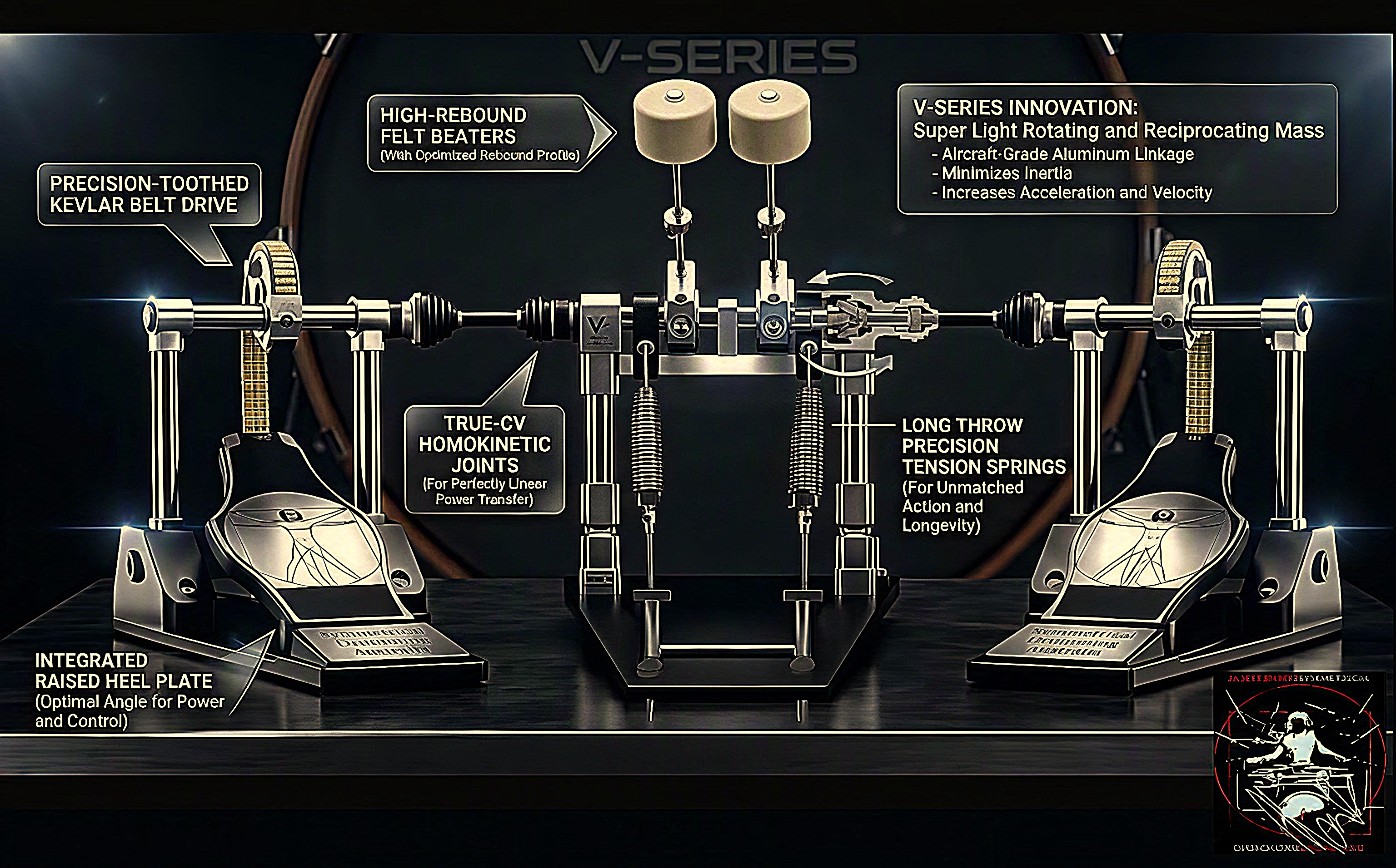
The double offset, CV driven, V Series.
By incorporating true CV joint geometry into the pedal design—parallel with concepts seen in Air Logic Pedals—my design resolves rotational ripple at the geometric source, delivering symmetrical feel and identical mechanical feedback across both feet regardless of kit placement.
Check out this pedal designed and built by me at Symmetrical Drumming Australia. So many more features in there as well.
Book a pedal alignment and setup at Symmetrical Drumming Australia.
https://symmetricaldrummingaustralia.org/engineering
Remember…even the best pedals have ‘ancient’ drive shafts! Its well past time for drum pedals to progress into the 21st century.
Get in touch and learn more!