Part 1:
The Machine That Stole Our Rhythm
—How Factory Economics Built the Modern Drum Kit

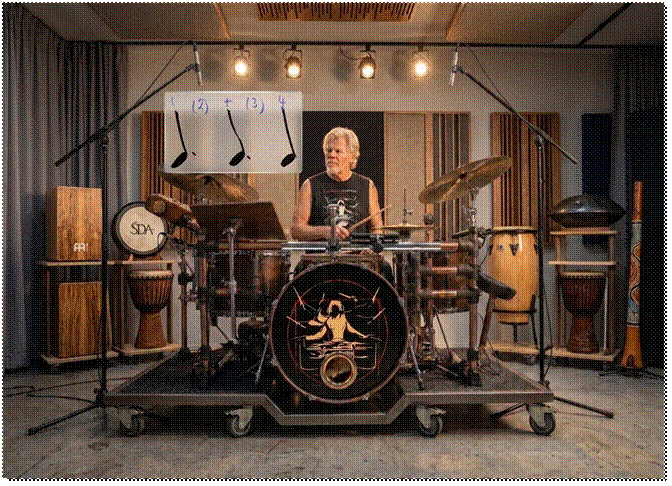
When you sit down at a standard drum kit, you are stepping into a machine designed over a century ago by forces that had almost nothing to do with music, anatomy, or human expression.
Look closely at the standard kit. Why is the right foot chained to a heavy bass drum pedal while the left foot operates a floor-bound or raised hi-hat? Why must the left hand cross awkwardly over the right arm to play the cymbals, twisting the torso and locking the spine into a permanent, asymmetrical slant?
For decades, drummers have accepted this crossed-arms posture as the immutable law of the instrument. But after 45 years behind the kit as a professional drummer, multi-percussionist, and hardware designer, I can tell you the truth: this layout was never built for the human body.
The Birth of a Mechanical Compromise
One hundred years ago, the modern drum set was hastily assembled out of a collection of singularly ancient instruments—European snare drums, Turkish and Chinese bronze cymbals, African and Asian tom-toms, and Ottoman marching bass drums.
When early 20th-century pioneers like Dee Dee Chandler began combining these disparate voices into a single station, they were caught in a brutal economic and logistical squeeze. Vaudeville stages were cramped. Jazz clubs were tight. Touring bands needed mobility. Hauling a full orchestral percussion section with multiple players was financially ruinous.
The solution was the "trap set"—a compact workstation that allowed one musician to do the work of four. But when production line manufacturing (Fordism) took off in the early 1900s, it hijacked the instrument's evolution. Factories optimized for the cheapest, most repeatable metal stampings and the most compact footprint. They didn’t consult anatomists or neurologists; they engineered hardware for the freight truck, the factory line, and maximum profit margins.
The Drum Kit as an "Averaging Engine"
At its core, the traditional drum kit became an averaging engine—flattening and standardizing not just physical posture, but the sounds and forms of its components into generic, mass-produced compromises.
As jazz tempos surged, makeshift physical adjustments—like stretching the low floor "low-boy" pedal up into the modern hi-hat—created new speed possibilities, but cemented a severe physical bottleneck. As percussion educator Claus Hessler notes, beginners left to their natural instincts frequently approach the kit open-handed, completely unaware of the industrial stereotype. They only adopt the crossed stance because of unconscious mimicry—copying high-profile players they saw on stage, film, and album art. What started as an industrial and logistical compromise became culturally fossilized as tradition.
We chained our bodies and our sonic palettes to a 20th-century factory layout. But modern drumming no longer needs that restricted form.
Part 2: The Brain and Body in Space
—Ergonomics, Ambidexterity, and Musical Freedom

Music is not merely sound vibrating through the air; it is physical energy shaped by a human brain and body moving through space. When your physical setup fights your biology, your musical vocabulary hits an invisible ceiling.
For over four decades, my life’s work has centered on a simple, liberating realization: true musical expression requires a brain and body in total spatial harmony.
The Myth of the Dominant Side
Traditional drumming treats the limbs like a hierarchy—the dominant hand and foot do the heavy lifting, while the non-dominant side plays supporting actor. This creates chronic muscle imbalances, repetitive strain injuries, and a lopsided musical voice.
When you strip away the industrial constraints of the standard kit and embrace bilateral expression and symmetrical ergonomics, everything changes:
- The Spatial Body: By mirroring your hardware layout, centralizing your hi-hats, and introducing double-offset pedals, your limbs move with natural, equidistant geometry. You stop twisting your torso and start operating with open-handed freedom.
- Neurological Integration: Symmetrical drumming trains both hemispheres of the brain equally. Instead of routing every complex rhythmic idea through a single dominant pathway, you unlock a fluid ambidexterity that lets your musical intent flow effortlessly into any corner of the kit.
Returning to the Source:
A Wider Percussive Palette
Why must we remain tethered to generic mass-produced shells? With the addition of ergonomic symmetrical pedal systems, the entire landscape of percussion is breaking open:
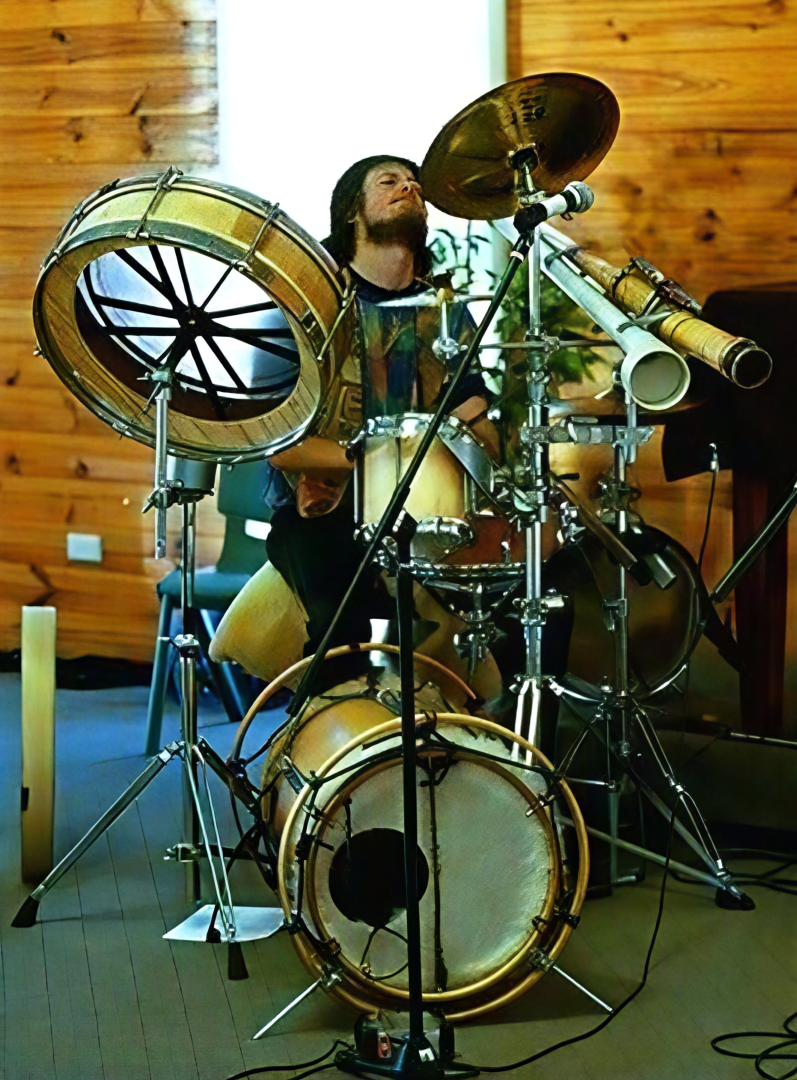
- Djembe kits with pedals bring organic, resonant hand drums directly into foot-driven grooves.
- Conga and bodhrán kits with pedals allow multi-percussive tonal colors to be driven with full-body coordination.
- The snare-tom function can finally return back to the pure, single percussive instruments from which they originally evolved.
- The cajón, equipped with new pedal-based adaptations, achieves an efficiency in space, size, and setup speed where even the drum stool and the bass drum can unify into a single, compact, highly mobile playing unit.
We are returning to a wider, richer percussive palette where every ancient voice is honored and liberated.
Part 3: Reclaiming the Rhythm
—The Symmetrical Drumming Revolution

After 45 years of research, performance, teaching, and hardware engineering, my philosophy as the founder of Symmetrical Drumming Global is built upon a dual foundation: ergonomic longevity and total bilateral freedom.
We no longer have to design our playing lives around the economic shortcuts of 1920s factory lines. We can design our instruments around the human organism.
Forging Ahead Beyond Non-Musical Limits
The next step in drum kit evolution is happening right now. At Symmetrical Drumming, we are forging ahead—building drum kits that transcend all the non-musical limits imposed by freight logistics and mass-production profit motives.
- Ergonomic Health: By eliminating twisted torsos, repetitive strain, and industrial bottlenecks, we extend a musician's playing life by decades. You can play smoother, faster, and longer—working with your biology instead of fighting it.
- Unrestricted Flow: When your hardware layout matches your body's natural symmetry and embraces hybrid acoustic forms, technical plateaus vanish. Rhythmic phrasing becomes as natural as walking or speaking.
An Invitation to Reimagined Play
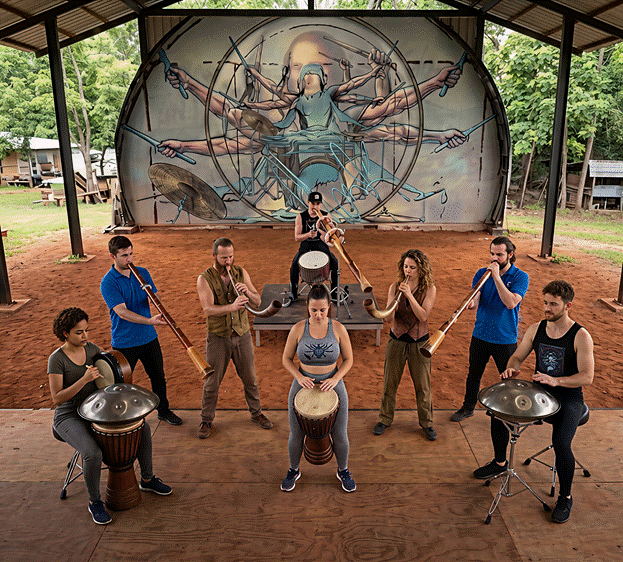
Whether you are an ambitious student breaking through technical speed bumps, an educator looking for modern, body-conscious pedagogy, or a performing professional seeking physical longevity, the path forward is clear.
It’s time to step out of the industrial cage. Let's honor the ancient roots of rhythm, respect the architecture of the human body, and build a truly symmetrical approach to sound.
Mark Campbell is a professional drummer, multi-percussion instructor, hardware designer, and the founder of Symmetrical Drumming Global.