Debunking the 432 Hz Myth
Frequency vs. Feeling:
Why I Don't Care About 432 Hz (And Why You Shouldn't Either)
If you spend any time browsing acoustic music, sound bath recordings, or handpan videos online, you’ve almost certainly run into the gospel of 432 Hz.
The claims are everywhere: 432 Hz is the secret frequency of the universe. It heals DNA. It aligns with the Earth. 440 Hz standard tuning was invented to make us anxious, but 432 Hz connects us to sacred geometry.
As someone who spends their life crafting compositions around the earthy rumble of the didgeridoo, the resonant steel of the handpan, and the grounding pulse of the bodhrán, with acoustic and electronic drumkits, I get why people are drawn to these ideas. We play acoustic, resonant, deeply visceral instruments. We want our music to feel organic and alive.
But here is the truth: the myth of 432 Hz is mostly bad math and revisionist history.
More importantly? Believing the myth actually misses what makes real acoustic resonance so powerful in the first place. Let’s break down the myths—and talk about where the real magic actually lives.
Myth 1:
Ancient Instruments and Classical Masters Were Always Tuned to 432 Hz
The Claim: Mozart, ancient civilizations, and Giuseppe Verdi tuned exclusively to 432 Hz until modern corporate standards forced 440 Hz upon us.

The Reality: Historically, pitch was all over the map.
- Before standardized tuning, organ builders, instrument makers, and local orchestras tuned to whatever felt right—or whatever string tension their instruments could physically handle.
- Historical pitch ranges spanned anywhere from 390 to 460!
- Mozart’s personal tuning forks were measured around 421.
- Giuseppe Verdi did support a standard pitch of 432 to save vocalist strain! but not because of cosmic energy—he simply wanted to save opera singers' vocal cords from rising concert pitch inflation (where 19th-century orchestras pitched higher to sound brighter).
When you play an ancient instrument like the didgeridoo, pitch isn't dictated by an arbitrary number system like "Hertz" (which relies on the modern human definition of a "second").
A didgeridoo's fundamental pitch is dictated purely by the physical length, bore diameter, and density of the eucalyptus branch carved out by termites. Nature doesn't care about a numerical tuning grid. And its random unless the instrument is tuned! Nothing special. All my didges are concert pitch (reference A440)
Myth 2:
432 Hz Matches the "Vibration of the Earth" (Schumann Resonance)
The Claim: 432 Hz is a direct harmonic multiple of the Schumann Resonance (the Earth's atmospheric electromagnetic frequency of 7.83 Hz.
The Reality: The math simply doesn't add up.
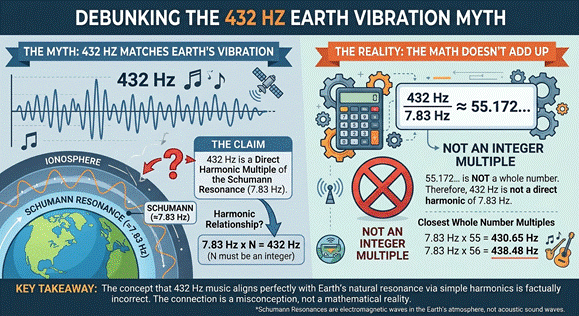
- If you divide 432 by 7.83 you get 55.17
- Furthermore, the Schumann Resonance measures electromagnetic waves in the upper atmosphere. Musical instruments produce mechanical pressure waves (sound) through air. They are entirely different physical forces.
- The Earth's resonance isn't a fixed integer anyway—it constantly fluctuates.
What a mess!!!!
When I hit a low, driving rhythm on the bodhrán, the feeling of groundness doesn't come from matching an atmospheric electromagnetic wave. It comes from the immediate, low-frequency acoustic pressure striking your chest cavity. It’s physical impact, not a mathematical equation. Its dependent on the immediate acoustic and proximity to the sound. Harmonising with the planet, and with the rest of the band…yeah but no but!!!!
Myth 3:
Middle C at 256 Hz is "Sacred Geometry"
The Claim: Tuning A4 to 432 hertz sets Middle C to 256 Hertz and that 2 to the power of 8 (a pure binary power of two).
The Reality: This only works if you use historical Pythagorean tuning or Just Intonation.
In modern 12-Tone Equal Temperament—the tuning system used by almost all modern fretted, keyed, and fixed-pitch instruments (including the handpan):
If your handpan is tuned in 12-Equal Temperament with A = 432 your Middle C actually sits closer to 257 than 256, breaking that clean power-of-two relationship
If you have a handpan in just intonation, it will have been custom built, be quite expensive, and will be slightly and annoyingly out of tune with pianos, guitars, keyboard percussion, woodwinds, etc.
You will, however, be able to play with vocalists, and fretless instruments as they will tune to you! They will have to play around your tuning and your instrument. You champ!!!
So…there is a bit of power trip involved in this 432 thing as well!!!
Where the Real Magic Lives:
Precise intonation, Timbre, Overtones, Rhythmic Accuracy and Groove, and Intention
If 432 Hz isn't a magical frequency, why do so many people swear that a 432 Hz handpan sound track feels warmer or more relaxing?
The answer is simple psychoacoustics: 432 Hz is roughly 31.8 cents (about one-third of a semitone) lower than 440 Hz.
- When you pitch any instrument down slightly, the string or shell tension relaxes.
- Lower pitches naturally carry less harsh high-frequency energy, making them sound "warmer," "darker," and less abrasive to human ears.
- But its all very very subtle, subjective, and difficult to quantify beyond confident assertions!
Tone Language and Pitch Expectation:
- Your brain continually projects expectations onto incoming audio streams.
- In speech recognition and musical perception, ambient noise is filtered out and missing audio fragments are filled in dynamically based on context, language patterns, and familiar acoustics.
- The brain interprets sounds unconsciously way before you become consciously aware!
Evolutionary Advantage: Speed Over Precision
| Feature | Objective Recording | Brain's Constructed Model |
|---|---|---|
| Primary Goal | High-fidelity accuracy | Immediate survival & actionable recognition |
| Processing Time | Slow (requires massive computing power) | Ultra-fast (uses shortcuts, heuristics, and assumptions) |
| Handling Ambiguity | Halts or displays raw noise | Fills in missing details with plausible guesses |
| Output | Exact data points | A simplified narrative of the environment |
The magic isn't in the number 432 or the other notes which reference that frequency for that octave! 432 is not measurably ‘better’ than 440!
The music is not in the tuning standard! There are many more notes sounding simultaneously in music.
We simply have to all be in tune to the same standard.
And we must not get hung up on which standard!
The magic is in shared precise tuning, timbre, dynamic control, and harmonics and overtones.
The Synergy of Didge, Handpan, DrumKit and Bodhrán
In my own compositions, resonance doesn't come from chasing a trendy internet tuning. It comes from how these distinct acoustic voices interact:
-
The Didgeridoo (The Fundamental drone): The rich drone of the didge provides a continuous fundamental frequency packed with upper harmonics. By manipulating vocal tract shapes and overtone singing, a single drone comes alive with motion.
-
The Handpan (The Harmonic Canopy): Steel handpans rely heavily on isolated fundamental, octave, and fifth overtones tuned directly into each tone field. When played over a didge, those handpan overtones ring out in pure acoustic harmony.
- The Bodhrán (The Pulse): The goat-skin head of the bodhrán provides a organic, expressive bass response. Tonal bending with the back hand allows the drum to breathe and pitch-shift naturally with the music, steering away from rigid, robotic grids.
-
The DrumKit: Provides the rhythmic scaffold above and below, wide left and right, upon which to build the other textures, flavours, and interactions!
Final Thoughts: Play What Moves You and do it well !!!
Music doesn't heal or move people because of an arbitrary number calculated in cycles per second. Music moves people because of precise standardised tuning, musician intention, phrasing and breath, rhythm, and acoustic texture.
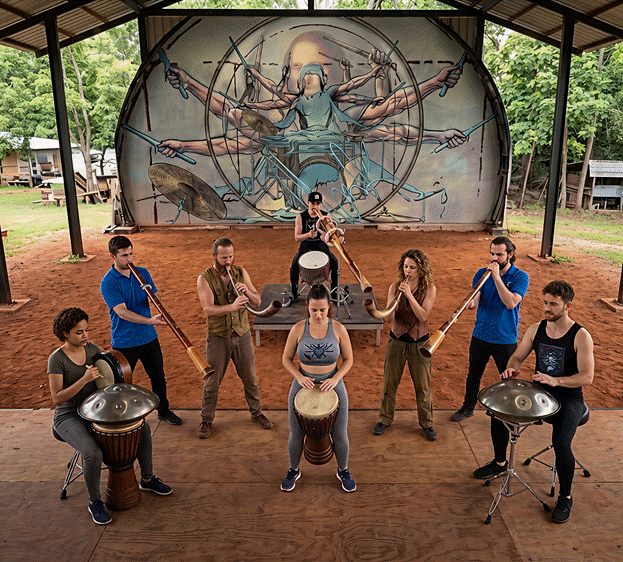
Whether a handpan is tuned to 440, 432, or 421, what matters is how the note rings out in the room, how it locks into the tuning of the other instruments such as the drone of the didgeridoo, and how the fundamentals and pulse of the drums, and bodhrán resonate in sympathy rather than annoyingly ‘beat’ against one another!
Stop stressing over the imposition of a tuning standard on your freedom (dont imbue mystic numbers or conspiracy into whats on the tuner). Setup to concert pitch and get into the music!!!!.
Then, Tune into the room, listen to the overtones, the flams, the groove, the mix beyond your individual sound and let the physical instruments speak to the band and the audience.
Remember, 432 is derived from bad mathematics and revisionist history (and a lot of selective perception)!!!
Your nervous system prioritizes rapid, low-latency detection of threats, movement, and patterns over absolute scientific accuracy. Sensory experience is an active prediction engine, constantly presenting a useful, real-time simulation of the external world.
Ditch the 432 hype!
What are your thoughts on tuning standards and acoustic resonance? Let me know in the comments below, or check out my latest track blending didgeridoo, handpan, kit, and bodhrán!
https://symmetricaldrummingaustralia.org/