Unlocking the Handpan:
A Comprehensive Guide to Modes, Grooves, and the Symmetrical Drumming Australia Approach
When beginning your journey with the handpan, it is easy to get lost in the sheer hypnotic beauty of the instrument. But have you ever wondered why your handpan can completely change its emotional character depending on how you play it?
Exploring the relationship between notes, modes, and external soundscapes unlocks a deeper dimension of musicality. This guide walks you through the 7 natural modes of F Major, explains why an external reference point is your secret weapon, and introduces a unique pedagogical approach tailored for aspiring handpan players.
The Secret of the Relative Modes of F
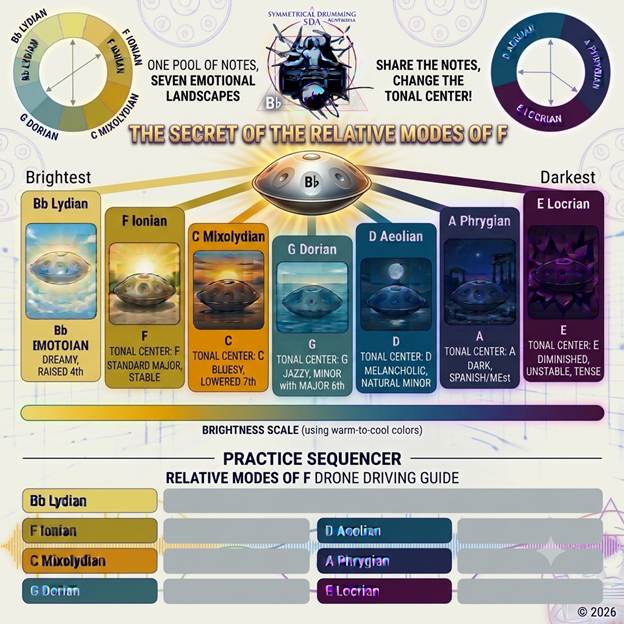
If you examine a handpan tuned to the key signature of one flat Bb you aren't just looking at a single scale—you hold a complete family of seven relative modes. Each mode shifts the tonal centre while sharing the exact same pool of notes, offering vastly different emotional landscapes.
|
Degree |
Mode Name |
Root / Tonic |
Notes |
Characteristic Sound & Feel |
|---|---|---|---|---|
|
I |
Bb Lydian |
Bb |
Bb– C – D – E – F – G – A |
Dreamy, floating, with a raised 4th |
|
II |
F Ionian (Major) |
F |
F – G – A – Bb– C – D – E |
Standard major, bright, and stable |
|
III |
C Mixolydian |
C |
C – D – E – F – G – A – Bb |
Bluesy, with a lowered 7th |
|
IV |
G Dorian |
G |
G – A – Bb– C – D – E – F |
Jazzy, minor feel with a major 6th |
|
V |
D Aeolian (Natural Minor) |
D |
D – E – F – G – A – Bb– C |
Melancholic, traditional minor sound |
|
VI |
A Phrygian |
A |
A – Bb– C – D – E – F – G |
Dark, Spanish, Middle Eastern flavour |
|
VII |
E Locrian |
E |
E – F – G – A – Bb– C – D |
Diminished, unstable, and tense |
Setting the Home Note: The External Reference Rule
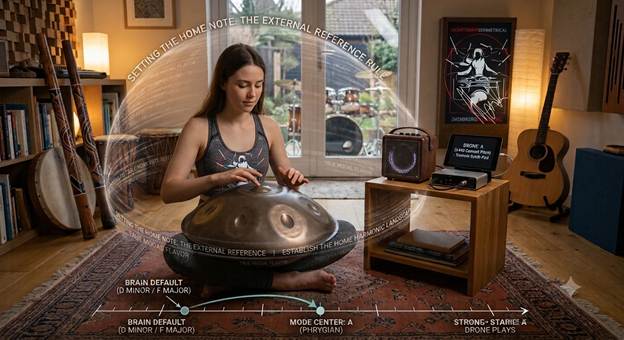
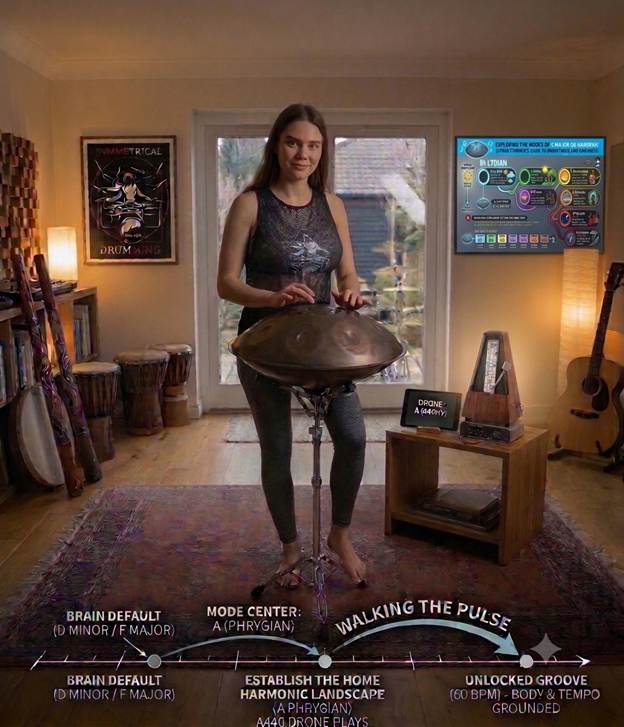
Here is a vital rule for beginner handpan students: Without an external reference (such as a drone or backing track) to set your Home Note, your brain automatically defaults to hearing the entire scale as D Minor / F Major.
True modal flavour requires an external ground. By utilizing a wide, sympathetic, slow-tremolo drone (like synth strings or a sustained pad) at A440 concert pitch, you establish the home harmonic landscape before you even strike a note.
Unlock the Groove
Whole-Body Embodiment
Step or tap your feet alternating Right, Left, Right, Left on every crotchet pulse (60 BPM). Feeling the pulse through your feet grounds the tempo from head to toe before your hands strike a single note.
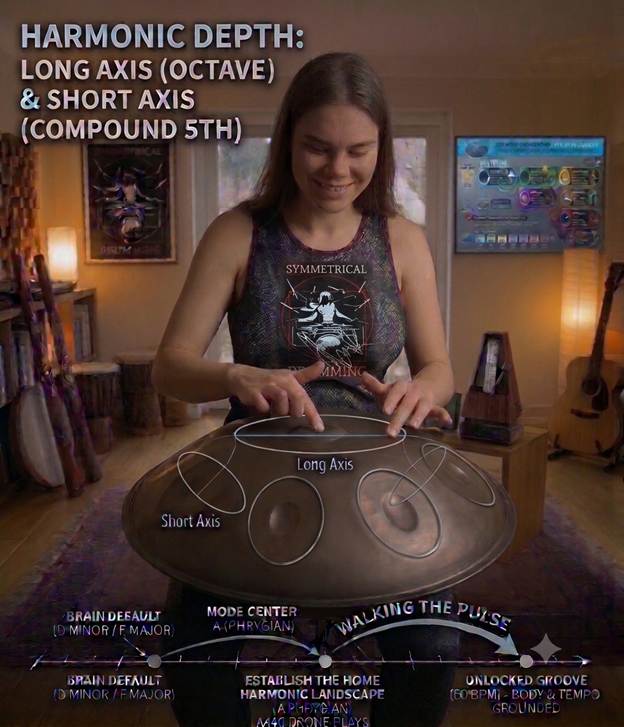
Harmonic Depth
Explore the harmonic octave along the long axis and the compound 5th along the short axis within each tone field.
Timbral Transitions
Integrate the shoulders and untuned surfaces of the instrument to create smooth tonal transitions between modes.
Globally Universal Patterns/Rhythms
Layer foundational rhythms over your foot pulse—such as the Tresillo (3+3+2), the Bembé (12/8 bell pattern), and the Paradiddle (RLRR LRLL)—to build independence and sticking dexterity.
The SDA Approach:
Beyond Solo Playing
Most handpan tutorials lock players into isolated, inward-looking solo habits. The Symmetrical Drumming Australia (SDA) philosophy changes the paradigm. Developed out of decades of multi-instrumental, rhythmic, and acoustic engineering experience, the SDA approach focuses intensely on the groove and the wider harmonic environment.
Rather than treating the handpan as a self-contained island, this comprehensive approach teaches you to integrate full-body rhythm, tone-field harmonics, and ensemble context into your daily practice.
Practice Sequence
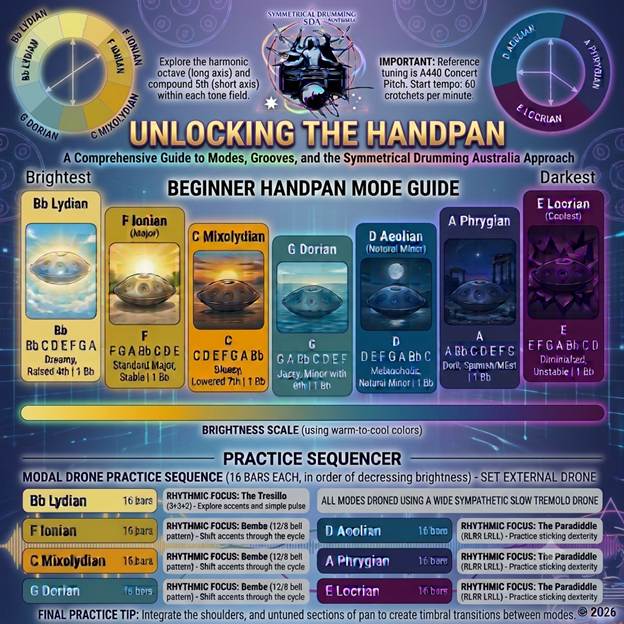
To put this method into practice, work through the following sequencer. Set your start tempo to 60 crotchets per minute, use a slow tremolo drone, keep your feet stepping on the pulse, and spend 16 bars per mode moving deliberately from brightness to darkness:
-
Bb Lydian (16 bars) – Rhythmic Focus: The Tresillo (3+3+2)
-
F Ionian (16 bars) – Rhythmic Focus: Bembé (12/8 bell pattern)
-
C Mixolydian (16 bars) – Rhythmic Focus: Bembé (12/8 bell pattern)
-
G Dorian (16 bars) – Rhythmic Focus: Bembé (12/8 bell pattern)
-
D Aeolian (16 bars) – Rhythmic Focus: The Paradiddle (RLRR LRLL)
-
A Phrygian (16 bars) – Rhythmic Focus: The Paradiddle (RLRR LRLL)
-
E Locrian (16 bars) – Rhythmic Focus: The Paradiddle (RLRR LRLL)
Learn More
Ready to elevate your percussion and handpan practice? Explore professional resources, courses, and custom tuition options at Symmetrical Drumming Australia.