Rewiring Your Practice: The Neuroscience, Somatics, and Systems of Elite Percussion Mastery

If you’ve ever sat down at the kit or your percussion setup with two free hours ahead of you, only to find yourself mindlessly noodling, checking your phone, or feeling utterly overwhelmed by everything you could practice, you aren't alone. Traditional "shedding" is often plagued by hidden friction, physical tension, and unfocused repetition.
To break through plateaus, we need to stop relying on brute-force discipline and start aligning our practice sessions with how the human brain and nervous system actually learn. By merging the cognitive neuroscience frameworks of Dr. Sahar Yousef (UC Berkeley Haas) with the polyvagal-informed somatic awareness of Adam Gust, and supercharging them with habit design (The 2-Minute Rule, SMARTER goals, and Pomodoro focus sprints), we can build an elite, repeatable system for musical growth.
Here is the ultimate blueprint for transforming your practice room into a high-yield laboratory.
Step 1: Crush Initial Resistance with the 2-Minute Rule
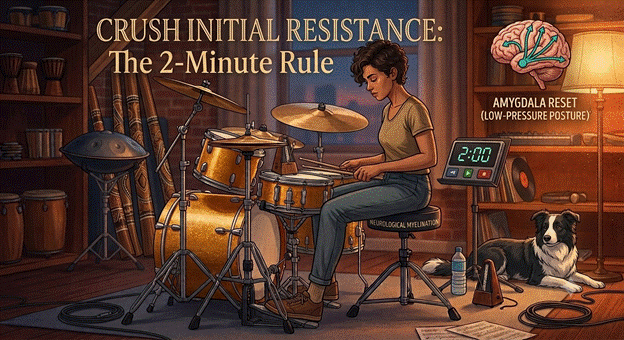
The hardest part of practicing isn't the physical exertion—it’s crossing the psychological threshold to start. The brain’s amygdala often registers a massive practice block or a frustrating technical challenge as a threat, triggering procrastination.
-
The Hack: Scale your entry point down so it takes two minutes or less to execute.
- Tell yourself: "I am just going to sit at the kit, anchor my feet, check my posture, and play a single smooth single-stroke roll or one handpan cycle for two minutes."
-
Why It Works: By shrinking the barrier to entry, you bypass your brain's threat response.
- Once you are physically seated and the initial friction is broken, momentum takes over, paving the way for deep focus.
Step 2: Define Precision Through the SMARTER Approach
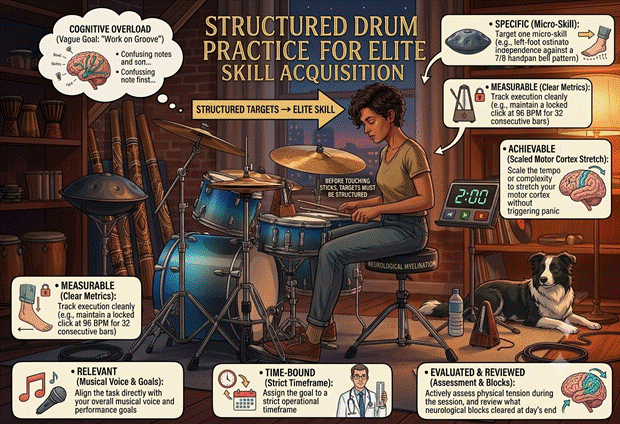
Drums and percussion present an infinite universe of study—rudiments, limb independence, dynamic control, odd meters, and tone production. Vague goals like "work on my groove" invite cognitive overload.
Before touching your sticks, your targets must be structured:
-
Specific: Target one micro-skill (e.g., left-foot ostinato independence against a 7/8 handpan bell pattern).
-
Measurable: Track execution cleanly (e.g., maintaining a locked metronome click at 96 BPM for 32 consecutive bars).
-
Achievable: Scale the tempo or complexity so it stretches your motor cortex without triggering panic.
-
Relevant: Align the task directly with your overall musical voice and performance goals.
-
Time-bound: Assign the goal to a strict operational timeframe.
-
Evaluated & Reviewed: Actively assess your physical tension during the session, and review what neurological blocks cleared at the end of the day.
Step 3: Execute High-Yield Focus Sprints (The Pomodoro-Somatic Integration)
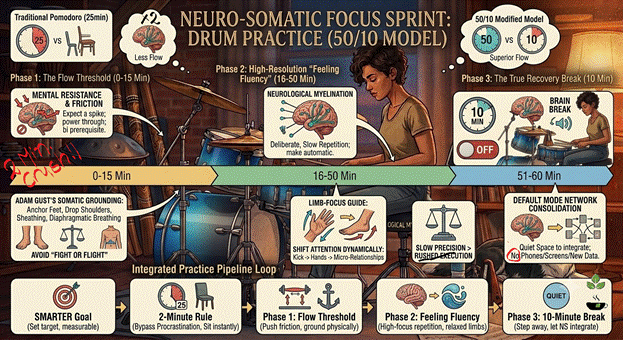
Traditional Pomodoro timers use 25-minute blocks, but cognitive neuroscience shows it takes roughly 15 minutes of uninterrupted, deep focus just to cross the threshold into a flow state. Therefore, a modified 50/10 structure yields superior results for complex motor skill acquisition.
Phase 1: The First 15 Minutes (The Flow Threshold)
Expect a spike in mental resistance as your brain switches gears. Power through this initial friction knowing it is a biological prerequisite for deep neurological adaptation. Simultaneously, integrate Adam Gust’s somatic grounding: anchor your feet, drop your shoulders, and establish deep, diaphragmatic breathing to keep your nervous system out of "fight or flight" stress.
Phase 2: Minutes 16 to 50 (High-Resolution "Feeling Fluency")
Now locked in flow, execute deliberate, slow repetition to drive myelination (the neural insulation that makes motor skills automatic). Shift your attention dynamically between limbs—isolate your focus entirely onto the kick drum, then the hands, then the micro-relationships between surfaces. Slow precision beats rushed execution every single time.
Phase 3: The 10-Minute True Recovery Break
When the timer hits 50 minutes, stop playing entirely. Step away from the instrument and your screens. Do not check your phone or process new data. Give your brain's Default Mode Network 10 minutes of quiet space to consolidate the motor patterns and neurological pathways you just built.
The Integrated Practice Pipeline
When you pull all these pieces together, your daily session becomes an unstoppable loop:
-
SMARTER Goal: Set a precise, measurable micro-target.
-
The 2-Minute Rule: Sit down instantly to bypass procrastination.
-
The First 15 Minutes: Push through cognitive friction while grounding your body physically.
-
Minutes 16–50: Execute high-focus repetition with somatic "feeling fluency" and relaxed limbs.
-
The 10-Minute Break: Step away completely to let your nervous system integrate the gains.
By treating your practice room as a intersection of neuroscience and somatic awareness, you'll spend less time spinning your wheels and more time making real, effortless musical progress.
Learn more at:
Symmetrical Drumming Australia