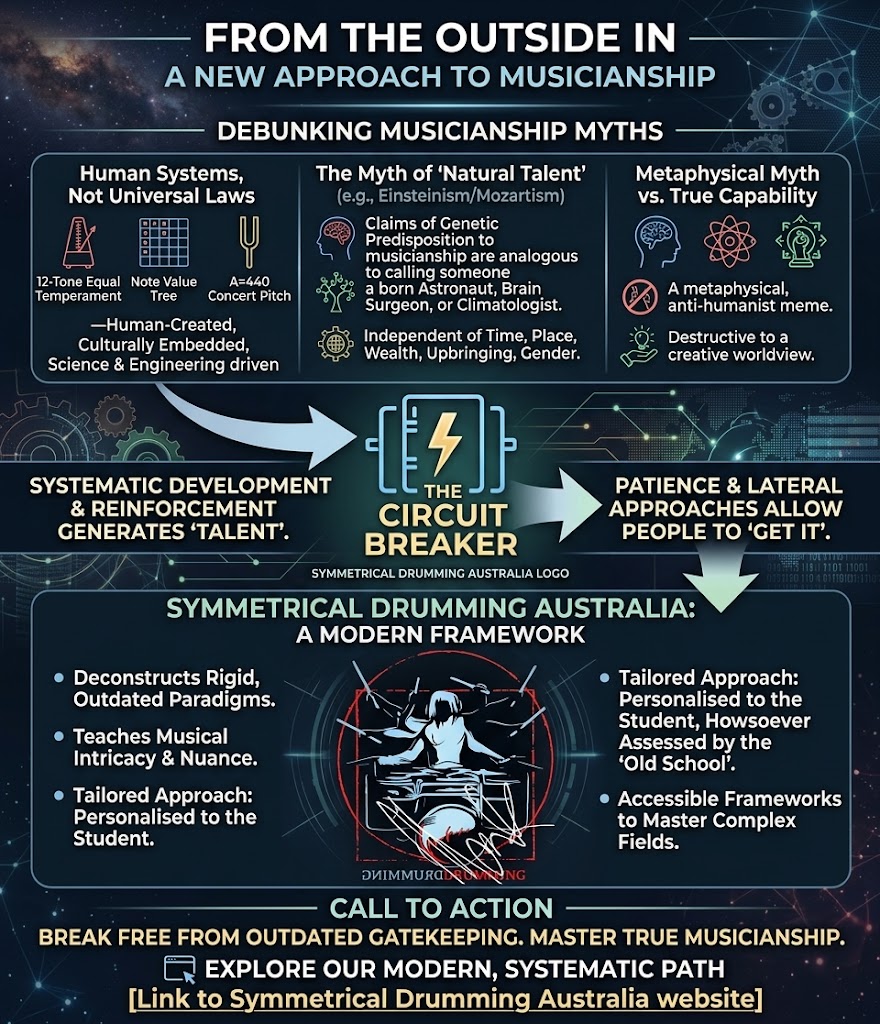
The idea that talent is an innate, mystical gift is one of the most persistent myths of human culture.
In reality, "talent" is an ahistorical meme—a social construct that is neither objectively defined nor universally understood.
When we dismantle this gatekeeping narrative, music and mastery cease to be exclusive clubs reserved for a chosen few and instead become accessible frameworks available to anyone willing to engage in systematic design.
1. The "Talent" Illusion: Ahistorical, Ill-Defined, and Culturally Bound
The modern Western obsession with "talent" is a surprisingly recent phenomenon.
Lack of Objective Definition:
- Science and psychology have repeatedly failed to identify a specific "genius gene" for complex skills like music. What we label as talent is usually a combination of early exposure, environmental encouragement, high-quality feedback loops, and thousands of hours of deliberate practice.
Cross-Cultural Differences:
- In many traditional cultures, music is not viewed as a specialized skill for a select few, but as a basic form of human communication—like talking or walking. In these societies, the concept of a "talentless" person makes as little sense as a "speechless" person.
A Historical Shift:
- For centuries, musicians were viewed simply as craftsmen and artisans. The Romantic era popularized the myth of the divine, tortured genius touched by cosmic fate. Today, this myth serves primarily as a form of gatekeeping, discouraging beginners before they even start.
2. "Talentless" World Changers Who Redefined Mastery
History is filled with figures who lacked natural gifts, formal training, or conventional "talent," yet changed the world through deliberate system design, relentlessness, and vision.
Historical Figure |
Conventional "Deficit" |
Systematic Breakthrough |
Impact |
|---|---|---|---|
Thomas Edison |
Deemed "too stupid to learn" by teachers; lost most of his hearing. |
Built an industrialized, team-based trial-and-error design framework. |
Invented the phonograph, motion pictures, and practical electric light. |
The Beatles (Early Years) |
Rejected by Decca Records for having "no future in show business." |
Played 8-hour sets night after night in Hamburg, refining their chemistry in a high-intensity feedback loop. |
Transformed global popular music and songwriting. |
The Sex Pistols / Early Punk Movement |
Virtually zero technical instrumental capability. |
Stripped music down to raw energy, three chords, and direct cultural commentary. |
Demolished industry gatekeeping and launched the DIY music revolution. |
3. Systematic Design: Rebuilding Musicianship on Your Own Terms
If talent isn't a cosmic endorsement, then musical mastery is an engineering problem. By replacing the myth of innate talent with structured frameworks, anyone can cultivate true musicianship:
- Deconstruct the Skill: Break music down into modular components—rhythm, ear training, ergonomic motor control, and tone production—rather than trying to "be musical" all at once.
- Optimize Feedback Loops: Use modern tools (recording setups, slow-motion playback, pitch analysis, targeted audio interfaces) to get immediate, objective feedback on your progress.
- Embrace the DIY Ethos: You do not need institutional permission or expensive conservatories to understand harmony, rhythm, and creation.
Key Takeaway: True musicianship isn't about inheriting a genetic lottery; it is about designing an environment and practice system where progress becomes inevitable.
Break Free from the Myth & Build True Mastery
Ready to bypass outdated gatekeeping and engineer your rhythm and musicianship through structured, accessible design?
👉 Explore systematic drum & percussion frameworks at Symmetrical Drumming Australia
