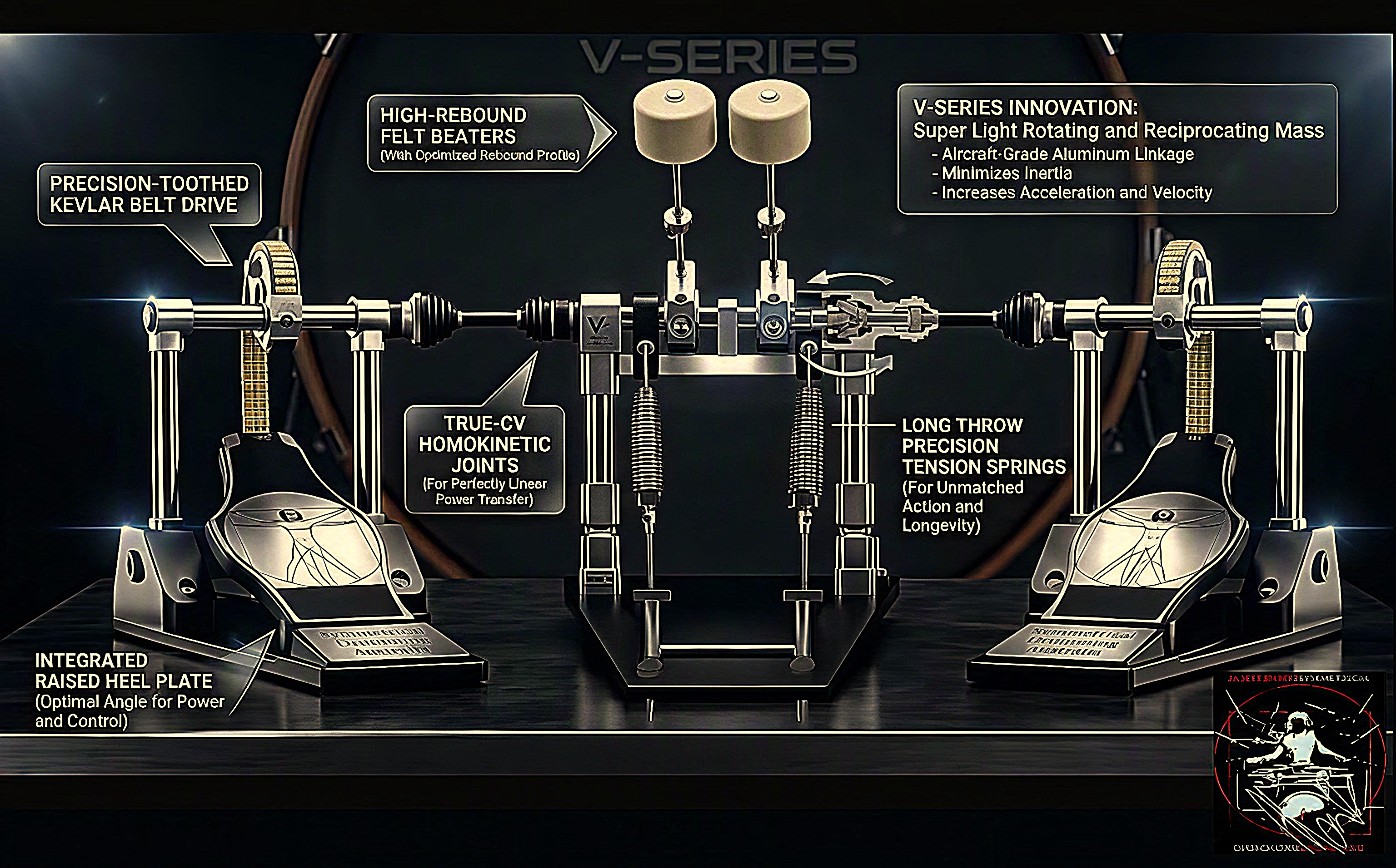
Think hard plastic kick beaters bounce faster than felt?
Physics says otherwise.
Discover the real science behind bass drum beater rebound and pedal feel.
Every drummer looking to build double-stroke consistency or increase their kick drum speed eventually gets the exact same advice in online forums:
“Ditch your felt beater and switch to hard plastic or wood. It gives you way more rebound.”
It sounds like pure common sense. Hard materials feel snappy, produce a sharp attack, and seem to fly off the drumhead effortlessly. Softer materials like felt are assumed to act like a pillow—absorbing your power and killing your footwork recoil.
Except collision physics proves the exact opposite.

1. The Physics of Impact: Inherent Bounce vs. System Rebound
To understand how beaters really behave, we have to look at the Coefficient of Restitution (e). This physics measurement calculates how much velocity an object retains after colliding with a surface, rated on a scale from 0 (a dead stop) to 1.0 (a perfectly elastic bounce).
If you take a hard plastic or wood beater and drop it onto a completely unyielding, rigid surface (like a slab of steel or a concrete floor), it won't bounce back in a useful way. It dead-stops with a loud thud.
Why Hard Beaters Have Zero Inherent Bounce
Hard plastic and wood do not deform upon impact. When a rigid beater strikes an unyielding boundary:
- No Strain Energy Storage: The material cannot compress to store energy.
- Instant Kinetic Loss: The impact energy converts directly into acoustic noise (a loud clap) and high-frequency shockwaves that travel straight up your pedal shaft into your foot.
Why High-Density Felt Acts Like a Mechanical Spring
Felt is made of millions of compressed, interlocking fibers. When a hard-compressed felt beater hits a surface, those microscopic fibers compress elastically. The felt stores the strain energy internally and then expands back out, actively pushing the beater head away from the impact surface.[ RIGID SURFACE ] <--- (Impact) --- [ BEATER MATERIAL ]
• Hard Plastic / Wood --> Instant energy loss to sound/shock (Inherent e ≈ 0.1 - 0.2)
• Hard Compressed Felt --> Internal strain energy elastic return (Inherent e ≈ 0.35 - 0.50)
2. Myth-Busting 3 Major Kick Pedal Misconceptions
Myth #1: "Plastic Beaters Bounce Faster Than Felt"
The Truth: Plastic beaters rely 100% on the drumhead acting as a trampoline.
Because hard plastic does not absorb impact or deform, 100% of your kinetic foot power is transferred into stretching the Mylar drum skin. The stretched drumhead is what hurls the beater back at your foot—not the plastic itself.
Myth #2: "All Felt Beaters Absorb Energy and Kill Recoil"
The Truth: Only soft, fluffy, or fleece-covered beaters deaden recoil.
Soft felt allows fibers to rub against each other, losing energy to friction. However, ultra-hard, high-density felt minimizes internal friction while maximizing elastic return.
It yields a springy recoil without needing a rock-hard drumhead.
Myth #3: "Beater Head Shape Is Only About Tone"
The Truth: Beater geometry directly alters your pedal's return speed.
-
Spherical / Crown Beaters:
- Create a tiny point of contact on the head. They release instantly without dragging across the Mylar, maximizing rebound velocity.
-
Flat-Faced Cylinders:
- Distribute force over a larger surface area, creating slight surface drag that can make double strokes feel heavier.
3. Matching Beater Density to Your Bass Drumhead Tension
Because rebound is a relationship between your beater material and drumhead tension, your ideal setup depends on how you tune your kick drum.
Scenario A: High-Tension / Un-Ported Bass Drum (Jazz, Classic Rock)
When your batter head is tuned medium-tight to high, the drumhead provides massive elastic return.
- Best Choice: Hard Plastic, Wood, or Medium Felt.
- Why: The drum skin does the heavy lifting, allowing hard materials to snap back instantly.
Scenario B: Low-Tension / Slack / Heavily Ported Kick (Metal, Funk, Modern Pop)
When your batter head is tuned loose for a deep, thumpy sound, the head loses its trampoline effect.
- Best Choice: Hard Spherical Felt (e.g., Vic Firth VicKick VKB1, Tama Cobra Felt).
- Why: Because a loose drumhead cannot throw the beater back, a high-density felt beater provides the internal elasticity required to spring off a "dead" head.
4. Quick Beater Material & Rebound Guide
Material Type |
Inherent Bounce (Off Rigid Surface) |
Drumhead Rebound (Off Tuned Head) |
Best Drumhead Match |
|---|---|---|---|
Hard Plastic / Acrylic |
Minimal (e ≈ 0.1 - 0.2) |
Maximum |
Medium to High Tension |
Hard Wood |
Very Low (e ≈ 0.15 - 0.25) |
Very High |
Medium to High Tension |
Hard Compressed Felt |
Moderate (e ≈ 0.35 - 0.50) |
High |
All Tensions (Ideal for Slack/Ported Heads) |
Soft Felt / Fleece |
Low (e ≈ 0.10 - 0.20) |
Low / Muffled |
Un-ported Jazz / Acoustic Sets |
The Takeaway for Drummers
If you play a tight kick drum and want a sharp, cutting attack, hard plastic or wood beaters will fly back effortlessly thanks to the drumhead's spring tension.
However, if you prefer a loose, slack kick drum for a deep sub-punch, relying on hard plastic will force your leg muscles to work twice as hard.
Switching to a hard, spherical compressed felt beater brings internal elasticity back to your pedal—giving you quick, effortless double strokes off a dead head.

Come figure it out at Symmetrical Drumming Australia
https://symmetricaldrummingaustralia.org/