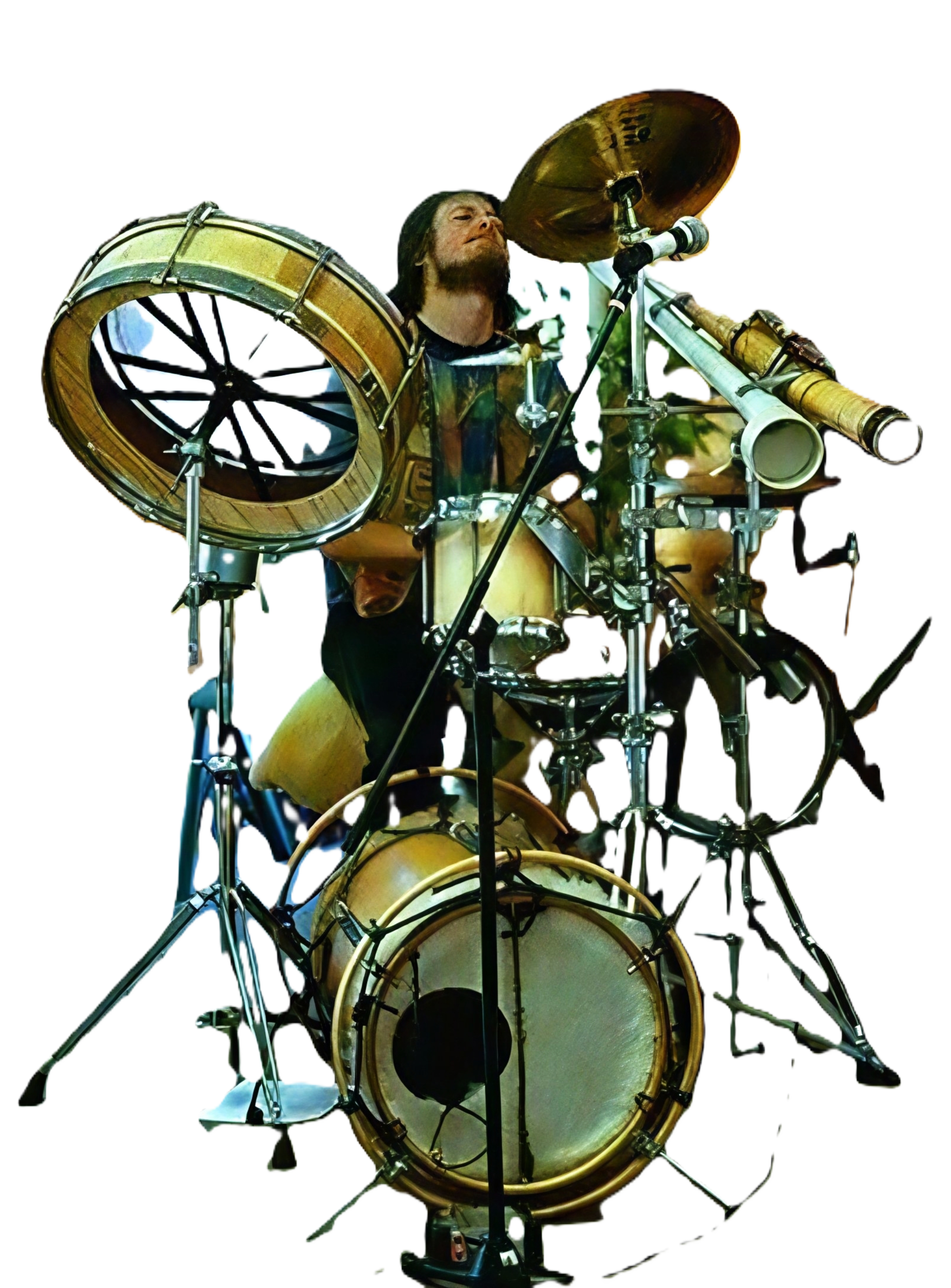
8Long-Term Drummers and Percussionists have ‘suped- up’ brains!
The Body in Question
In a drummer’s body, saltatory conduction is the biological engine behind lightning-fast reflexes, complex polyrhythms, and four-limb coordination.
While saltatory conduction happens in everyone's myelinated nerves, a drummer’s intensive training forces the nervous system to adapt through a process called myelination—essentially upgrading their "biological wiring" from standard internet to fiber-optic speeds.
Here is how saltatory conduction fundamentally shapes and optimizes a drummer’s body and performance:
1. Maximising Signal Speed for Rapid Tempo
Drummers often have to execute precise movements in fractions of a second (such as executing a rapid 180 BPM double-stroke semi quaver triplet roll)[66mS]
- The Mechanism: Instead of the nerve signal traveling slowly down the entire length of the axon (continuous conduction), saltatory conduction allows the electrical action potential to "leap" from one Node of Ranvier to the next. [1, 2]
- The Drummer Advantage: This accelerates the signal up to 120 meters per second. This near-instantaneous communication allows a drummer’s brain to command the hands and feet with microsecond accuracy.
2. Upgrading the Brain's "Main Highway" (The Corpus Callosum)
Neurological research indicates that experienced drummers possess fundamentally altered brain structures compared to non-musicians.
- Thicker Nerve Fibres: Brain imaging studies show that drummers have fewer but significantly thicker, highly myelinated nerve fibres in the anterior Corpus Callosum—the bridge connecting the left and right hemispheres of the brain.
- Hyper-Fast Cross-Talk: Because these fibres are heavily wrapped in insulating myelin, saltatory conduction occurs at peak efficiency.
- This allows the left and right hemispheres to exchange timing and motor information incredibly fast, which is exactly what allows a drummer to play a steady jazz swing triplet ride cymbal pattern with the right hand while improvising syncopated rhythms with the left hand and ostinato-ing and creating pulse with feet.
3. Energy Efficiency and "Sparse Sampling"
Drumming is an intense physical workout.
If a drummer’s nervous system relied on inefficient continuous conduction, their motor neurons would burn through massive amounts of cellular energy (ATP) just trying to fire the muscles repeatedly.
- Energy Savings: Because myelin acts as an insulator, the exchange of sodium and potassium ions only happens at the exposed nodes.
- The metabolic "pumps" only have to reset the electrical balance at these tiny gaps, rather than across the whole nerve.
- Sparse Sampling: Neuroscientists have noted that because a drummer's brain paths are so efficiently myelinated, their motor areas actually show less activity than a beginner's during a performance.
- This phenomenon, known as Sparse Sampling, means the brain performs complex physical feats with minimal effort, preventing neurological fatigue.
4. Refining Limb Independence via the Cerebellum
To prevent your non dominant foot (hi-hat) from copying what your right foot (bass drum) is doing, the brain must send distinct, perfectly insulated commands.
Through repeated practice, the brain triggers neuroplastic changes in the cerebellum (the brain's movement coordinator).
Myelin sheaths are laid down around these specific pathways, locking in "muscle memory" by optimizing saltatory conduction routes so that signals do not bleed into adjacent nerve pathways.
At Symmetrical Drumming Australia Mark Campbell has been drumming for 45 years. His brain is a drummer's brain. Book a lesson on kit, percusdion, Bodhran, Djembe, Cajon, handpan, and or Didge….and start re-wiring your brain to DRUM!
After 45 years of intensive drumming—especially with an ambidextrous and balanced approach like Symmetrical Drumming Australia—Mark Campbell's motor pathways and connecting brain tracts would feature maximally thickened, highly efficient myelination.
What is Myelination?
Brain Changes After 45 Years of Drumming
- Corpus Callosum Strengthening: Studies on professional drummers show that the corpus callosum—the main bridge connecting the left and right halves of the brain—develops thicker, well-insulated fibers. This lets both sides of the brain talk to each other instantly.
- Ambidextrous Balance: Because Mark Campbell uses a setup that treats both sides of the body equally, his brain splits physical coordination tasks evenly across both hemispheres.
- Energy Efficiency: Decades of practice create a state called sparse sampling. His brain uses less overall activation energy to move his hands and feet because the pathways are completely streamlined and automatic.
- Cerebellar Growth: The cerebellum controls timing, rhythm, and physical balance. Decades of heavy multi-limb coordination result in denser microstructures in this region.