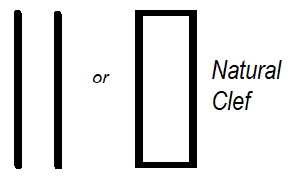
Natural Clef
Drum notation typically uses the natural clef, also known as the percussion clef, instead of a treble, bass, tenor, or alto clef.
Lines and Spaces
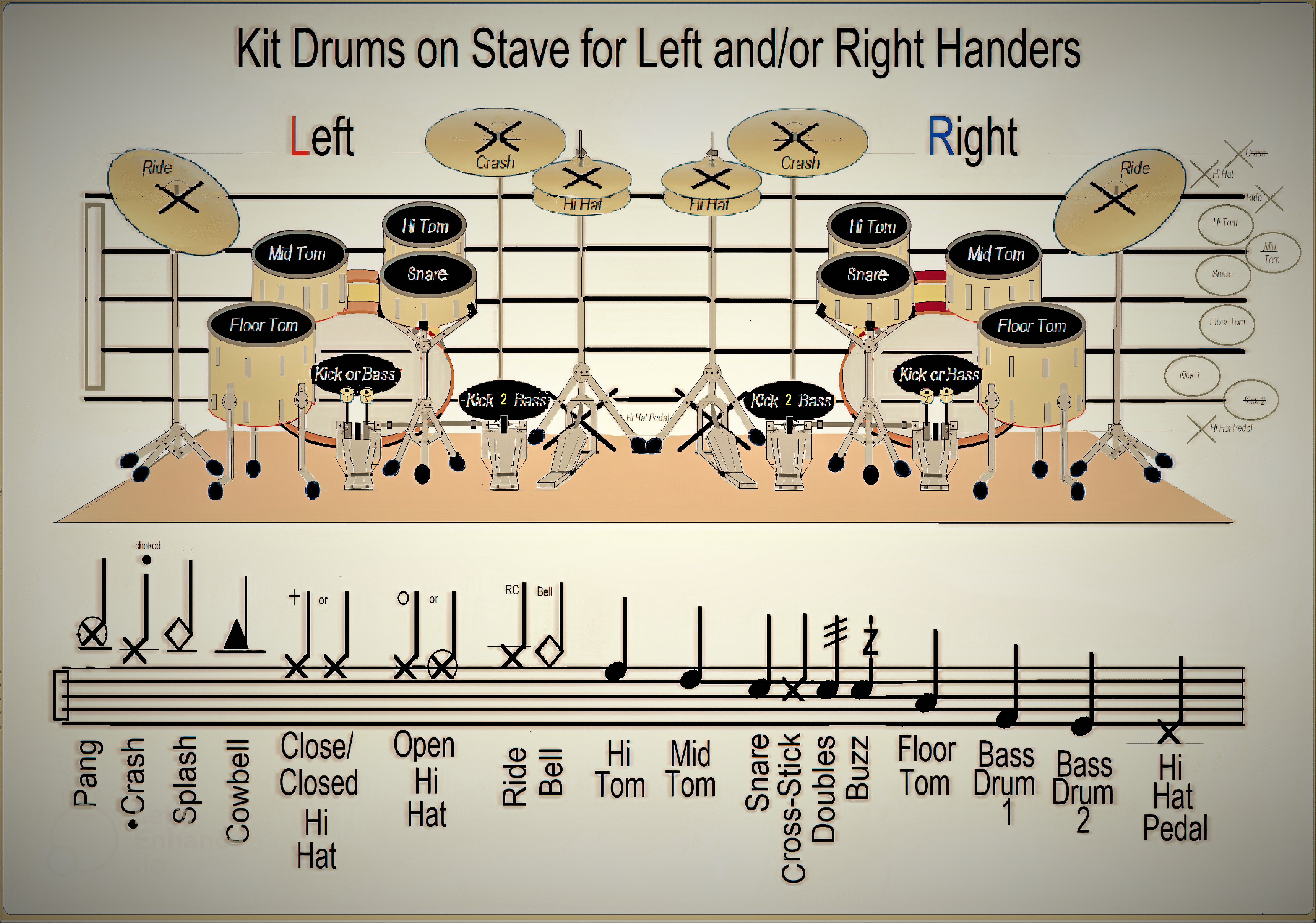
The bass drum, snare drum, floor tom, and rack toms (hi tom and low tom), each have a space on the staff and are written with an elliptical notehead.
Notation for all Instruments
Notation for Conga, Bodhran, Djembe, Cajon, and Didgeridoo vary widely…but the drumset schema (to be consistent) on the stave can be used…ie: low pitch sounds are low on the stave high pitch placed high on the stave and the cross, diamond, triangle and elliptical noteheads to indicate specific sounds.
Written Notation as a means to an end
Notation in music is a tool for communication…a tool to assist memory…a tool to share ideas fast and precisely…and a quick way to modify and update a rhythm…its not perfect (far from it), but without written notation (of any type) we have to rely on verbal and aural transmission of ideas in music…'word' of mouth and imitation works well (historically proven) but when we add written notation to the mix … things get clearer to ‘see’ in one's ‘mind’s eye' and as well as hear in one's ‘Mind’s Ear' combine the two and music becomes easier to impart,remember, remind, revise, and update.
Notation is a guide
The fine nuance involved in maintaining pocket and groove (the warp and weft of the rhythm) cannot be notated. This is where years and years of strategic practice comes to the fore.
Please see the poster I designed below. This poster below includes the view from the left hander as well as right.