What Type of Instrument is a Didgeridoo?
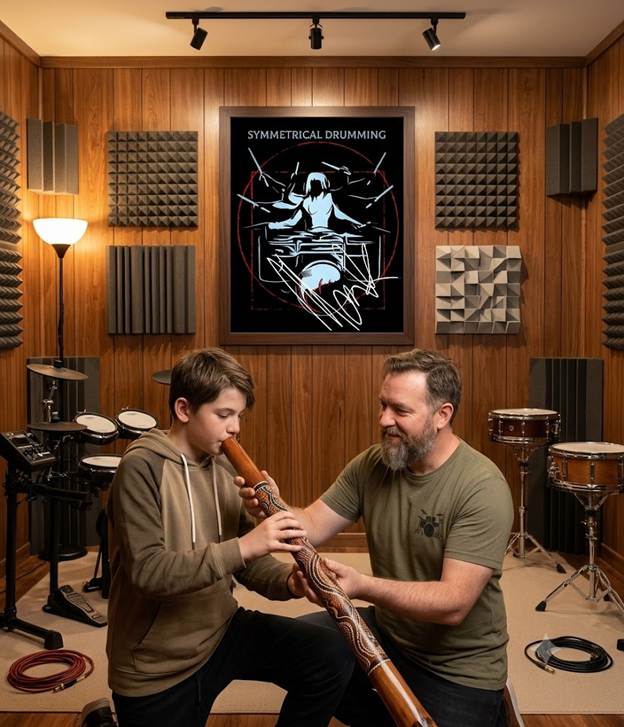
The didgeridoo is classified scientifically as an end-blown aerophone. As a natural wooden wind instrument, its organic construction and acoustic behavior place it in a unique category, sharing physical and performance characteristics with ancient brass and woodwind instruments around the world—most notably the Irish Bronze Age horns.
1. Acoustic Classification: The End-Blown Aerophone
In the Hornbostel-Sachs instrument classification system, the didgeridoo belongs to the aerophone family because sound is generated by the vibration of a column of air without the use of vibrating strings or membranes.
-
The Player As the Reed: Unlike a clarinet or saxophone that uses a wooden reed, or a flute that splits air across an embouchure hole, the didgeridoo relies on the player's lips as the vibrating element.
-
The Acoustic Tube: The player's buzzing lips introduce sound waves into the wooden bore, which acts as an acoustic resonator. While often likened to a straight trumpet due to its cylindrical-to-conical wooden form, its organic interior allows for complex acoustic feedback, overtones, and continuous fundamental drone frequencies.
2. Historical Parallels: The Irish Bronze Age Horns
Though separated by thousands of years and vast geographic distances, the Irish Bronze Age horns (such as the ancient cornán or wooden and bronze horn prototypes) offer a fascinating structural and technical parallel to the didgeridoo.
-
Size and Scale: Many ancient Irish horns match the approximate length and bore scaling of traditional didgeridoos, resulting in a similar fundamental pitch range.
-
Embouchure and Technique: Playing these ancient horns requires the same foundational lip-buzzing control, breath support, and resonance as the didgeridoo. While Irish horns were cast in bronze or fashioned from hollowed wood to project martial or ceremonial calls across fields, both instruments rely entirely on the performer's embouchure elasticity and diaphragmatic support to shape tone and volume.
3. The Functional Term: The "Dronepipe"
Because the primary acoustic output is a continuous, hypnotic fundamental pitch, the didgeridoo has frequently been referred to as a dronepipe. Unlike melodic wind instruments that rely on finger holes to change notes (though traditional didgeridoos are un-holed, relying on vocal tract modulation and overblowing for timber shifts), the dronepipe emphasizes:
-
Sustained Resonance: Maintaining a steady, uninterrupted acoustic wave.
-
Circular Breathing: Integrating nasal inhalation with oral exhalation to sustain the drone indefinitely—a technique mirrored in various long-tube trumpet traditions globally.
Expanding on the concept of the dronepipe—the defining acoustic classification for instruments like the didgeridoo and ancient horn traditions—reveals a fascinating intersection of physics, human biology, and organic instrument design.
The Anatomy of a Dronepipe: Acoustic Mechanics
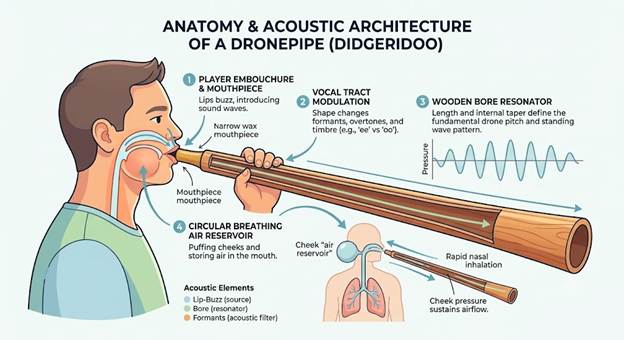
A dronepipe functions fundamentally as a naturally resonant acoustic column. Unlike melodic instruments that alter pitch via tone holes or valves, a traditional un-holed dronepipe relies entirely on continuous acoustic excitation, air pressure, and vocal tract modulation.
-
The Continuous Fundamental Wave: When a player's lips buzz into the mouthpiece end, they introduce a standing sound wave into the wooden bore. The length and internal taper of the tube determine the primary drone pitch.
-
Vocal Tract Filtering (Formants): Because the human vocal tract acts as an adjustable acoustic filter inside the instrument's column, players can change vowel sounds inside their mouth (e.g., shifting from "ee" to "oo") to carve out higher overtones and timbral shifts without changing the fundamental root note.
-
Circular Breathing Integration: To maintain an uninterrupted drone indefinitely, the player stores air in their cheeks while inhaling rapidly through the nose, using cheek pressure to sustain the air column through the pipe during inhalation.