Start Now!
Starting drum lessons is a major milestone, but parents and aspiring adult learners often wonder: When is the right time to begin? While the short answer is that ages 6 to 7 represent the sweet spot for structured learning, the true answer depends on developmental readiness, physical ergonomics, and individual goals.
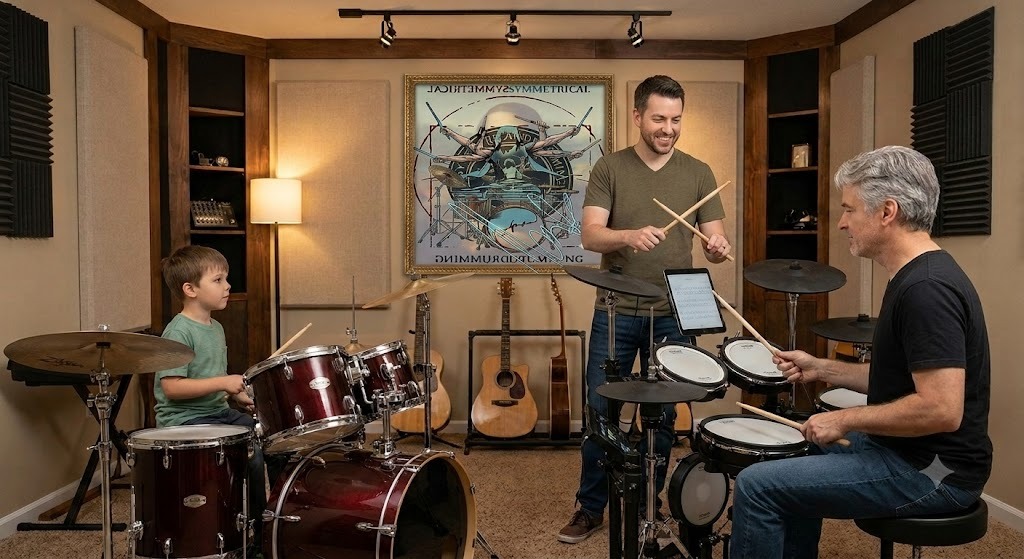 The Developmental Sweet Spot: Ages 6 to 7
 The Developmental Sweet Spot: Ages 6 to 7
By ages 6 to 7, children typically reach key developmental milestones that make formal drum instruction rewarding and effective:
- Sustained Attention & Focus: Children at this age can generally maintain mental focus for 20- to 30-minute lesson windows and follow multi-step instructions.
- Basic Physical Coordination: Gross motor skills have developed sufficiently to coordinate independence between hands and feet.
- Fundamental Literacy & Counting: Understanding basic numbers (counting to 4 or 8) directly translates into reading rhythm notation and keeping steady time.
Early Childhood (Ages 3 to 5): Foundation Through Play
For children under 6, formal, rigid drum kit instruction can sometimes lead to frustration. However, early musical exploration is invaluable.
- Focus on Rhythm Play: Use hand drums, shakers, body percussion, and tabletop drumming to teach steady pulse, dynamic control (loud vs. soft), and listening skills.
- Keep It Fun: At this stage, music should be an interactive, play-based exploration rather than strict technical practice.
Key Readiness Indicators (Beyond Age)
Age is just a number; functional readiness is what matters most. A prospective student is ready for structured drum lessons when they show:
- Physical Ergonomics: The ability to reach the pedals and drum pads comfortably without straining or posture distortion (child-sized drum kits or specialized setups help tremendously).
- Impulse Control & Hearing Safety: The maturity to wear protective hearing gear consistently and follow safety instructions around acoustic drum volumes.
- Interest & Motivation: A genuine desire to play driven by internal curiosity rather than external pressure.
Teenagers & Adults: It’s Never Too Late
A common misconception is that drumming must be started in early childhood to achieve mastery. In reality, teens and adults possess distinct advantages:
- Cognitive Efficiency: Mature learners grasp music theory, rhythmic structure, and practice routines much faster than young children.
- Analytical Problem Solving: Adults can intentionally break down multi-limb independence, technique, and ergonomics.
- Neuroplasticity & Health: Drumming at any age stimulates cross-brain communication, improves motor speed, enhances focus, and serves as an exceptional physical and mental workout.
Suggested Outline to Expand Your Post
If you are drafting or updating this blog article, consider organizing it into these key sections:
- Introduction: Highlight that age 6–7 is the general starting point, but emphasize that readiness varies by individual.
- Early Years (3–5): Preparing the mind through rhythm games, hand percussion, and auditory training.
- The Gold Standard (6–12): Why early primary school age idealizes physical independence, focus, and rapid skill acquisition.
- Teen & Adult Beginners: Busting the myth that starting later limits potential; highlighting brain health and stress relief.
- Practical Checklist for Parents: Simple criteria to evaluate if a child is ready (reach, focus, hearing protection compliance).
Learn More at