The Hi Hat was invented about a century ago.
It allows the drummer/percussionist to bring two cymbals together with a ‘chick’ or a ‘splash’ sound using the foot …freeing up the hands for other parts of the groove.
It (HH) was originally called sock cymbal and was down low…by the foot (hence sock)…The Hi Hat, along with the Bass Drum Pedal (kick pedal) are the key hardware components that briing the feet into groove!
The Hi Hat (spelled that way…not High Hat)…is a sock cymbal with an extension (internal rod and external pipe) to bring up to a level playable with the drumsticks (as well as the foot)…making a very adaptable and textured instrument!
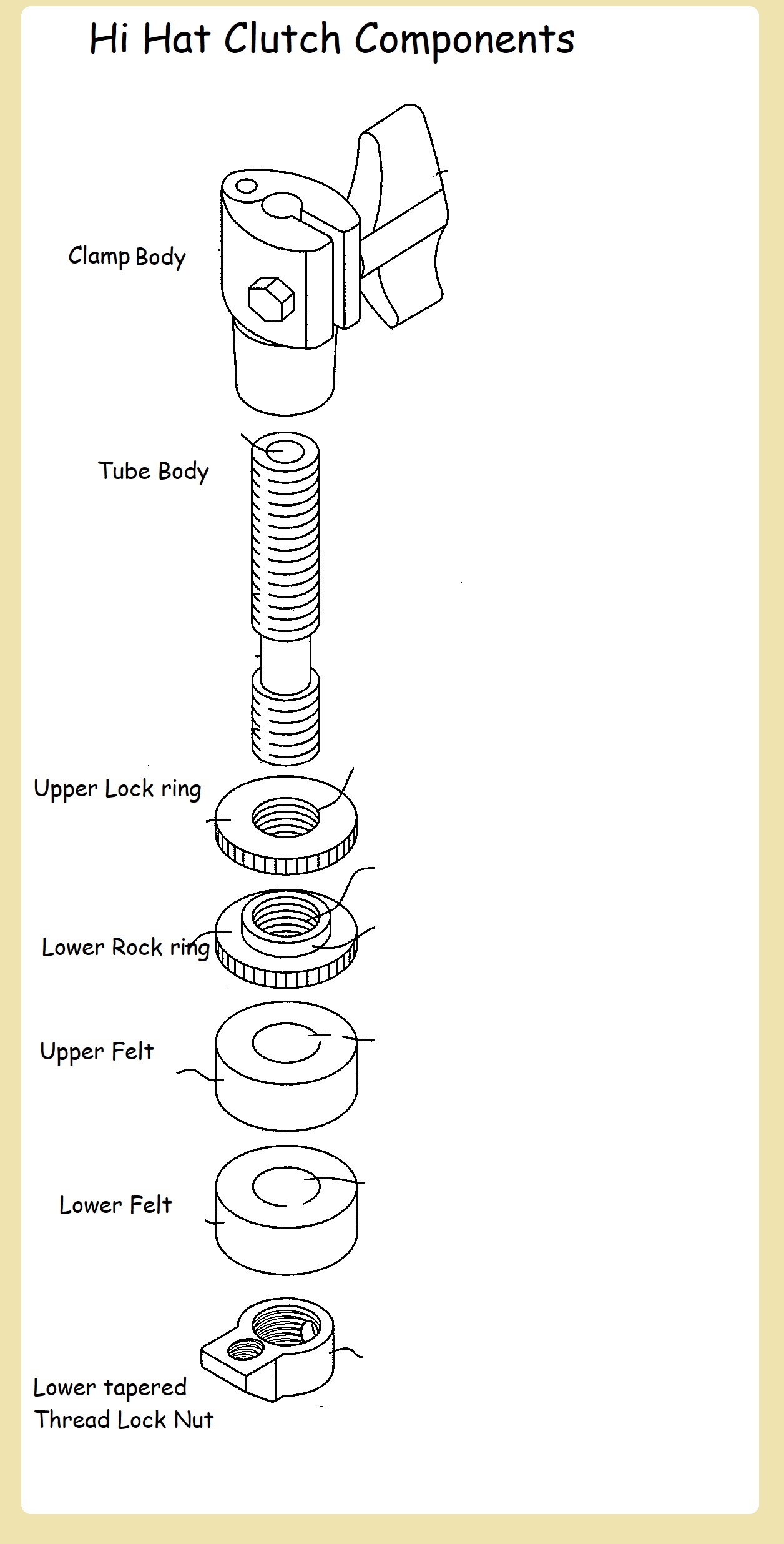
The HiHat Clutch joins the top HiHat cymbal to drive rod (allowing the foot to move it up and down). The clutch therefore has to ‘clamp’ to the drive rod, and the the top cymbal (but in a way that allows that cymbal to move and and resonate)
To accomplish this the clutch has seven main components…and these components need to be assembled correctly to protect the cymbal from damage, allow for adjustment, and facilitate quick assembly and disassembly.
Components List:
- Main body
- Clamp Bolt
- Upper pressure ring nut.
- lower lock ring nut
- Upper Felt Washer
- Lower Felt Washer
- Bottom lock ring.
(A ‘Drop Clutch’ - for quick release, has even more components).
Mixing up the order of components is common when starting out, quirky dysfunctional arrangements are sometimes perpetuated from one ‘folkloric’ drummer to the next for years….
Getting it right, learning what goes where, is essential for a good HiHat sound, damage free operation, and an adjustable unit. There are locking functions specific to the upper and lower cymbal lock rings . The lower lock ring is (in most cases) a tapered thread (self locking as it screws onto the tube body). These get mixed up far to often.
Being a drummer is about rhythm and groove, tone touch and texture…but it also very much about the mechanics of your instrument…fudging the assembly and setup of your pedals, hihat, stands, racks, mountings is not the sign of a pro-drummer! Learning to play on gear that is not setup and adjusted correctly will slow your progress, make accuracy difficult to achieve, and at worst cause strain and injury.
Mechanical setup skills, assembly skills, and mechanical understanding of your pedals, stand, mountings, and connection is critical to a good sound, ergonomic setup, and precise predictable and ergonomically optimal drumming.
At Symmetrical Drumming Canberra, lessons include the setup of pedals, hihats, stands, mountings, racks and optimisation of the entire setup to suit the player.
Book a free chat and come in and see the mechanical mastery at the heart of Marks drum kits, percussion kits, and individual instruments.
https://marcuscampbellorum.com/free-lesson
Many thanks
Mark